
HVAC performance changes
A system begins operating outside its expected range.
Investigate → maintain / repair / optimize / replace
CMI connects measurement, analysis, prioritization, modernization, verification and repetition — while MOS maintains the evolving operating record that allows each decision to inform the next.
The cycle is the differentiator. Verification is not the end of the work; it creates new evidence and returns the building to the next decision.
Establish what exists and what the evidence shows.
Understand performance, condition, alternatives and economics.
Determine what should happen and when.
Implement the selected change with the appropriate technical and execution resources.
Measure the result against the reference and expectations.
Use what was learned to identify the next decision.
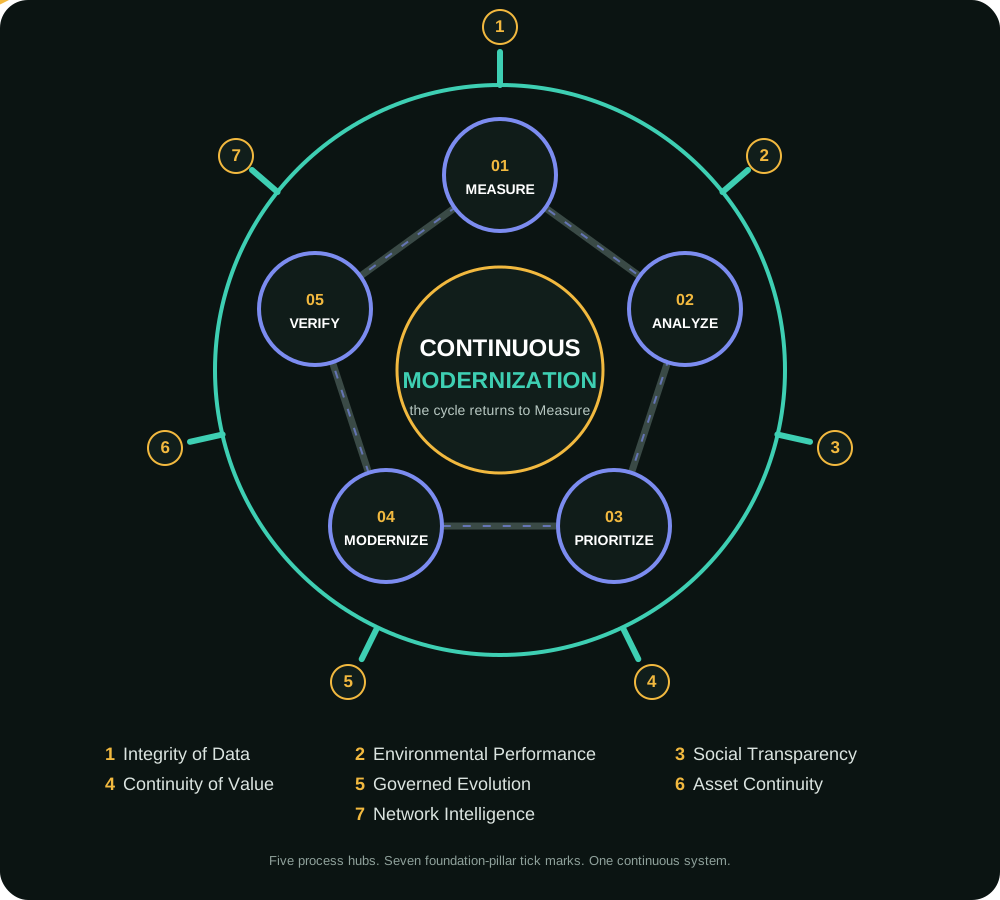
Existing systems can detect a performance change. ModSystems helps connect that change to the larger modernization decision.
A system begins operating outside its expected range.
Investigate → maintain / repair / optimize / replace
Production falls below expected performance.
Investigate → clean / repair / optimize / replace
Consumption changes unexpectedly.
Analyze → understand the cause → determine the response
An asset reaches a condition, age or maintenance threshold.
Evaluate → maintain / refurbish / replace / defer
The trigger does not make the decision. It starts the decision process.
A modernization decision considers the full situation and the value that may be created or protected. Energy cost is important, but it is only one dimension.
Aging equipment, rising maintenance exposure, inconsistent indoor conditions, high energy use, changing operations, limited capital, environmental requirements, or an asset that may still have useful life.
Economic, environmental, operational, human and social value — while managing capital, implementation risk, resilience and the evidence needed to support responsible decisions.
Performance, condition, energy, maintenance, technology, carbon and resource effects, indoor environment, operating requirements, timing, capital, risk, asset life and potential future value.
Continue operating, monitor, optimize, repair, refurbish, replace, defer, redeploy, finance, or combine actions — depending on what the analysis supports.
The result is a decision, not a predetermined equipment recommendation: what to change → when → why → expected value → how to verify.
Existing buildings already contain assets, operating history, maintenance exposure, energy consumption, constraints and opportunities. ModSystems starts there and continuously determines what should change, what should remain and when action makes sense.
Build the practical record from information already available and add targeted measurements where they improve the decision.
Capture maintenance, performance, modernization and verified results so the next decision does not start from zero.
For new development, the same discipline can begin during planning and design, then continue through construction, commissioning and operation.
Connect objectives, stakeholders, technology, infrastructure, operations and future requirements.
Preserve the intended operating logic as systems are selected, installed and commissioned.
Carry the asset record forward into the same continuous modernization cycle used for existing environments.
The method does not require a finished software platform to begin. ModSystems can work from the information an owner already has, adding targeted measurements or integrations where they materially improve the decision.
Architects use AI. BIM organizes design information. Digital twins model physical systems. BMS/BAS controls equipment. Sensors and meters create operational evidence. Financial and maintenance systems capture another part of the story.
ModSystems is designed to connect those sources to the owner’s long-term economic and modernization decisions rather than replace the systems themselves.
A capability for analysis, pattern recognition and decision support — not the entire operating system.
Design, asset and modeled-system information that can contribute to the evolving record.
Operational evidence from the physical environment.
The framework that connects evidence, economics, decisions, implementation and verification.
ModSystems sits above the systems that already operate the physical environment. BMS, meters, maintenance systems, engineering teams, contractors and other technologies each provide part of the picture. ModSystems connects that information to the economic and modernization decisions that determine what should happen next.
It is the layer between what the asset is doing today and how the asset should evolve tomorrow.
Operates and controls building systems. ModSystems uses relevant information from those systems rather than replacing them.
Collects and displays information. ModSystems connects that evidence to economic and modernization decisions.
Designs technical solutions. ModSystems helps determine what should be changed, when, why, and how the result should be verified.
Maintains assets and restores function. ModSystems incorporates condition and maintenance exposure into longer-term modernization decisions.
Provides a point-in-time assessment. ModSystems is designed to continue after the assessment and revisit decisions as conditions change.
Implements defined improvements. ModSystems can work with qualified implementation and energy-service partners while maintaining the decision and evidence loop.